Why Falling Back in Love With Science Changes Everything At Any Age
- Home
- Why Falling Back in Love With Science Changes Everything At Any Age
Ask most adults about their school science classes, and you’ll often hear some version of the same story: memorizing formulas for a test, dissecting something they didn’t want to touch, or sitting through a lecture that never quite explained why any of it mattered. It’s no surprise that so many people grow up believing they’re “just not science people.” But that belief is almost always less about ability, and more about how science was taught the first time around.
Our Science Program at EABT exists to offer something different — a second chance to discover that science, taught well, isn’t intimidating. It’s genuinely fascinating.
Science as a Way of Understanding the World
At its core, science isn’t a subject confined to textbooks and laboratories — it’s a way of asking questions and finding answers about the world we live in every day. Why does bread rise? How does the body fight off illness? Why do certain materials conduct electricity while others don’t? Why does the sky change color at sunset? These aren’t abstract academic questions; they’re the kind of everyday curiosities that, once you understand them, make the world feel a little more comprehensible and a lot more interesting.
Our Science Program is built around reconnecting students with that natural curiosity — whether they’re encountering these concepts for the first time, or finally getting the explanation that never quite clicked in school.
A Hands-On, Experiment-Driven Approach
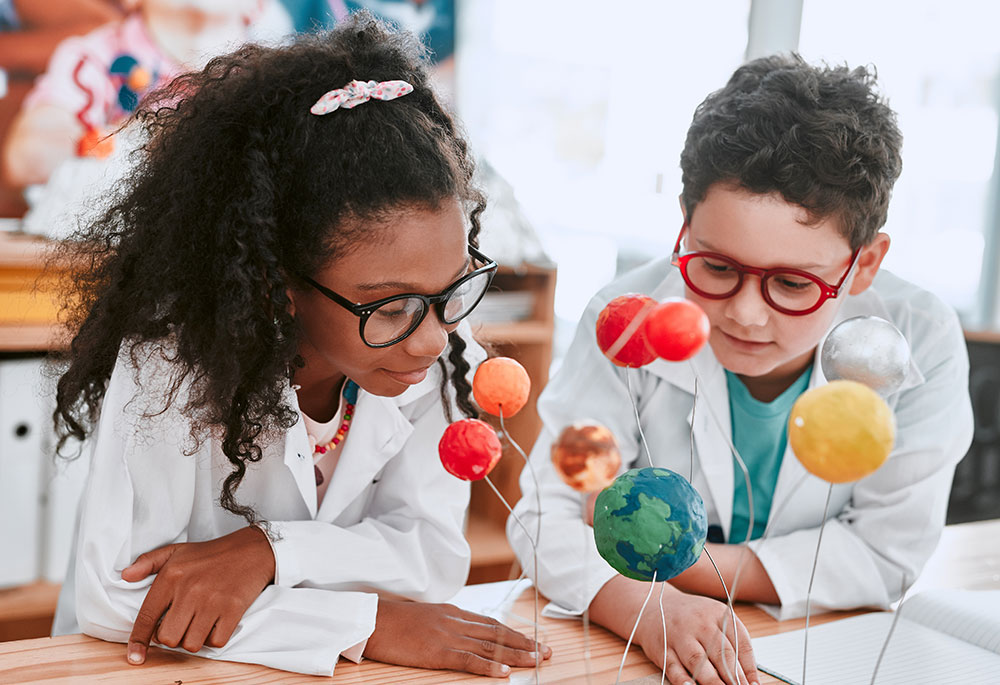
One of the biggest differences between our program and a traditional science classroom is the emphasis on direct experience. Science is not a spectator subject. You don’t truly understand a chemical reaction by reading about it — you understand it by watching it happen, predicting the outcome, and seeing whether your prediction was right.
Throughout the program, students engage in guided experiments and applied activities designed to make abstract concepts tangible. Physics principles come to life through simple, hands-on demonstrations. Biological concepts are explored through observation and discussion rather than rote memorization. Chemistry becomes less about balancing equations on paper and more about understanding what’s actually happening at a molecular level — and why it matters.
This approach matters because genuine understanding sticks. Information memorized for a test tends to disappear shortly after; concepts understood through direct experience tend to stay with you for life.
Built for Every Level, From Curious Beginners to Academic Support
Our Science Program serves a wide range of students. For younger learners and academic support students, the focus is on building strong, confident foundations — making sure core concepts are genuinely understood, not just memorized long enough to pass a test. For more advanced students, the program moves into deeper scientific reasoning, encouraging critical thinking, hypothesis testing, and a more sophisticated understanding of how scientific knowledge is built and tested.
What ties every level together is the same core philosophy: science makes the most sense, and becomes the most enjoyable, when it’s connected to real curiosity rather than disconnected obligation.
Instructors Who Make Complexity Feel Approachable
Our science instructors share a particular gift: the ability to take a complex concept and explain it in a way that feels genuinely clear, without stripping away what makes it interesting. They understand that many students arrive with some hesitation — perhaps past experiences that made science feel difficult or unwelcoming — and they work patiently to rebuild that confidence from the ground up.
Small class sizes allow for real interaction: questions get answered in the moment, misunderstandings get caught and corrected early, and students feel comfortable admitting when something doesn’t make sense yet, rather than quietly falling behind.
Why Scientific Thinking Matters Beyond the Classroom
Even for students who have no intention of pursuing a scientific career, the reasoning skills built through this program carry real value. Scientific thinking — forming a hypothesis, testing it, analyzing evidence, and adjusting your conclusions based on what you find — is a transferable skill that strengthens decision-making and critical thinking in virtually every area of life and work.
In an era increasingly shaped by misinformation and oversimplified claims, the ability to think scientifically — to ask “how do we actually know that?” — has become more valuable than ever.
Who Joins This Program?
Our science students include:
- Children and young learners building strong academic foundations
- Students who need additional academic support to catch up or strengthen specific areas
- Adults rediscovering subjects they once found intimidating in school
- Anyone genuinely curious about how the natural world works, regardless of age or background
What You Walk Away With
By the end of the program, students receive an official EABT Certificate of Completion. But just as importantly, many leave with something they didn’t expect: a renewed sense that science isn’t a closed door reserved for “certain kinds of people.” It’s a way of understanding the world that’s genuinely accessible to anyone willing to ask questions and look closely.
Ready to Begin?
Whether you’re a student needing extra support, a parent looking to strengthen your child’s foundations, or simply someone who never got the chance to truly enjoy science the first time around, it’s never too late to discover what makes it so compelling.
Contact us today to learn more about enrollment, schedules, and how to join our next Science Program in Berlin.